

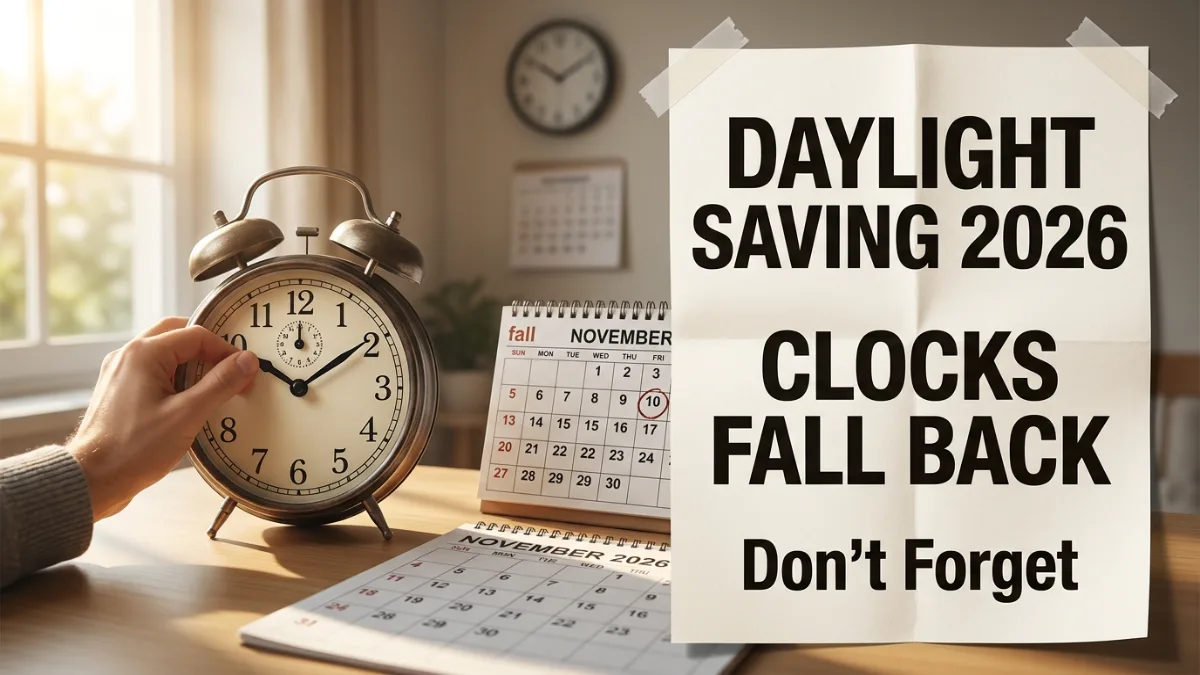
Daylight Saving Time 2026: Twice a year, hundreds of millions of people across North America and Europe shift their clocks by one hour, disrupting sleep schedules, confusing calendar apps, and prompting the same question every time: did I remember to change the clock in the kitchen? Daylight Saving Time 2026 ends on Sunday, November 1, when clocks in participating regions fall back one hour at 2:00 a.m. local time. The change brings an extra hour of sleep that night and noticeably brighter mornings through the autumn and winter months. But it also shortens the afternoon and has well-documented effects on sleep, productivity, and even road safety in the days that follow. Here is what you need to know about this year’s time change and how to prepare for it.
DST 2026 End Date and Details
In the United States and Canada, Daylight Saving Time ends on November 1, 2026, at 2:00 a.m. local time, when clocks are set back to 1:00 a.m. This applies to all participating states and provinces. In the United Kingdom, the clocks fall back one week earlier, on October 25, 2026, when British Summer Time concludes. Most European Union countries also make the switch on the last Sunday of October, meaning residents across much of Europe will have already returned to standard time by the time North America follows suit.

The one-hour window that repeats
When clocks fall back, the hour between 1:00 a.m. and 2:00 a.m. technically occurs twice in a single night. This brief overlap can create real-world complications for time-stamped systems. Hospitals that record patient arrival times, airlines managing overnight flight schedules, and financial trading platforms that log transactions by the second all need to account for the ambiguity that arises during that repeated window. For most people the impact is invisible, but for those working night shifts on November 1, it means an extra hour on the clock before the shift ends.
Which Regions Observe the Change
Not every region observes Daylight Saving Time. In the United States, the two notable exceptions are Arizona, which stays on Mountain Standard Time year-round, and Hawaii, which does not participate at all. Within Arizona, the Navajo Nation does observe DST, creating a patchwork of time zones within the same state. In Canada, most provinces adjust their clocks, though Saskatchewan remains on Central Standard Time throughout the year. India, Japan, China, and most countries near the equator do not observe any form of seasonal time change.

Australia reverses the cycle
Readers in the Southern Hemisphere follow the opposite pattern. Australia, for example, begins Daylight Saving Time in October and ends it in April, aligned with the Southern Hemisphere’s seasonal calendar. New South Wales, Victoria, South Australia, and the Australian Capital Territory all participate, while Queensland, Western Australia, and the Northern Territory do not. This reversal can be a source of genuine confusion for anyone scheduling international calls or meetings between, say, Toronto and Sydney during the transition weeks when the two hemispheres are briefly moving in opposite directions.
Sleep and Health Effects of Falling Back
The autumn time change is generally better tolerated than the spring shift, simply because gaining an hour feels less disruptive than losing one. However, experts say that even a one-hour change is enough to disturb the body’s circadian rhythm, particularly in the days immediately following the switch. The earlier onset of darkness in the evening can trigger a premature rise in melatonin production, leading to fatigue and, in some individuals, a low-level dip in mood that persists for several days as the body recalibrates to the new light schedule.

Road safety risks in the days after
According to experts, the period following the autumn clock change is associated with a modest but measurable increase in road accidents, particularly in the late afternoon and early evening hours when drivers are now travelling home in darkness rather than twilight. A study of traffic data across multiple countries found that this elevated risk is most pronounced in the first week after the change. The pattern is less severe than what occurs after the spring forward shift, but it remains a reason for drivers to exercise extra caution during the November commute.
How Devices Handle the Time Change
Most modern smartphones, laptops, and smart speakers update their clocks automatically on the night of the change, provided the device’s time zone settings are correctly configured. The update typically happens silently in the background. Where people are most likely to encounter an unchanged clock is in appliances that lack internet connectivity: microwave ovens, older car dashboards, wall-mounted analogue clocks, and some bedside alarm clocks. Think of the common frustration of waking up on the Monday after the change and seeing your car clock showing an hour that no longer matches your phone — a minor inconvenience that tends to linger for weeks.

A brief history of the spring and fall shift
The United States did not observe a nationally consistent version of Daylight Saving Time until the Uniform Time Act of 1966, which standardised the start and end dates across participating states. Before that legislation, individual states and even cities set their own clocks independently, creating a logistical tangle for broadcasters, railway operators, and anyone crossing a state line. The current November end date was fixed more recently: the Energy Policy Act of 2005 pushed the end of DST in the U.S. from the last Sunday of October to the first Sunday of November, a change that took effect in 2007.
Ongoing Debate Over Permanent Time
The debate over whether to eliminate the twice-yearly clock change has intensified in recent years on both sides of the Atlantic. In the United States, the Sunshine Protection Act, which would establish permanent Daylight Saving Time and eliminate the autumn rollback, has been introduced in Congress multiple times but has not yet passed into law. In the European Union, a directive to end seasonal clock changes was approved by the European Parliament in 2019, but implementation has been delayed as member states struggled to agree on whether to fix their clocks on permanent summer or permanent standard time.

Why agreement has proven difficult
The core disagreement is not whether to stop changing clocks — most experts and surveys of the public suggest broad support for that — but which time to keep permanently. Proponents of permanent standard time argue it better aligns with natural daylight and produces measurable health benefits, particularly in relation to sleep quality and cardiovascular indicators. Supporters of permanent DST point to economic benefits, including more evening daylight for retail, hospitality, and outdoor recreation. According to experts, the health evidence currently tilts toward permanent standard time, though that position remains contested in policy circles and varies by latitude.
Disclaimer: The information in this article is provided for general informational purposes and is based on publicly available data at the time of publication. Time change dates and regional participation may vary and are subject to changes in legislation. Readers are advised to verify current clock change schedules through official government or timekeeping sources relevant to their location.



Comments